Blog Immersive Technology Governance Gap: What Leaders Miss When Tech Moves Faster Than Policy Interview with Amy Peck

So, Amy, can you first start by sharing who you are, what you do, and most importantly, what is the spark that got you into this field?

Amy Peck: I founded Endeavor XR, originally Endeavor VR, back in 2014 when we were very focused on VR and training, because that’s where the data was, the ROI, and the traction. Since then we’ve expanded into digital twins, understanding data flows, real-time 3D, and real-time insights. The spark for me was VR. I was leading enterprise at Leap Motion and I moved to San Francisco from New York to take that role. It coincided with the release of the first Oculus DK1. Our engineers duct-taped a Leap Motion to the front of a DK1 and built a little game called Shark Punch with Chaotic Moon. You go in VR and you punch away sharks. When I first saw that, I thought this can fundamentally change how businesses work. I researched true pioneers like Tom Furness, Jackie Morie, Nani de la Peña, and Philip Rosedale. Then I jumped off into what I call the abyss of consulting, because you hang your shingle and you don’t know if anyone is going to come.

What was a moment when an idea turned into something with a real impact?

Amy Peck: During COVID we had conversations with a number of pharma companies who were pushing out these COVID drugs, and that required a lot of changes to their manufacturing lines. Some were being built from the ground up and some were changeovers from existing lines. We worked with one in particular on a digital twin of a changeover of an existing manufacturing line, leveraging digital twin across the board. There’s a lot of compliance that goes into these lines, there’s a lot of ergonomic testing, and then there’s training for the people who are going to manage the line. With a digital twin, and a very strong partner who built it, it was essentially build it once and then use it across all of these avenues to make sure they were ticking all the boxes, compliant, and training up the workforce so that day one they could get on the line and know what their roles were. It was one of those wins in a moment of tremendous uncertainty.

Expert Amy Peck, that focuses on immersive technology via EndeavorXR.

Are there some examples when XR becomes an enabler, where instead of optimizing workflows, it enables something that was impossible before?

Amy Peck: We’re very aligned in that thinking. When I work with clients, I promote the idea of parallel paths to the future. The first path is optimizing existing business practices, operating in an arena you already know, trying to do it better and faster. That results in incremental change, and incremental improvement is important. But where we are now, it’s more true than ever that we’re not taking the time to rethink our systems. Are the systems that we’re improving the ones that are going to lead us meaningfully into the future? Leaders have to think not only about optimization, but what the products and services of the future are, and the kernel of that is how we want to live in the future. I don’t want to make predictions. I want to architect something meaningful. The leaders who are most successful have that vision, and they bake that north star into shifting paradigms in current business and even economic constructs.

So when we think about those leaders, how can they find the direction and then shape the organizations or teams they lead?

Amy Peck: It comes down to teams and your workforce. The most incredible ideas about shaping the future can come from anywhere in your organization. PayPal was one of the early companies to use this kind of innovation, and Amazon uses it as well. They set aside a small amount of capital and they have a mechanism to take in ideas and projects. One core rule is you build a small team, you come up with your idea, and you’ll get 10, 15, 20,000 to iterate and get to some kind of proof of concept. The most important piece is that no one on that little innovation team can be on your day to day team. You have to have five people from different disciplines. You can’t have everyone in the same lane and become hive minded. Different perspectives, different lifestyles, different approaches to business bring color to ideas you would not get if you were all working in the same team.

What are you currently working on and what are you excited about right now?

Amy Peck: I’m excited about many things. I’ve been doing a lot of work in the Middle East and Central Asia, and I’m hoping to start a project with a company that is building the kind of innovation hub we’ve been talking about. I did a workshop with them a couple of months ago, and in 90 minutes, with one of my partners, we had 40 high level executives come up with 15 viable ideas out of about 30, which is a pretty good hit rate in 90 minutes. They’re in financial services and real estate, so a very specific business, but that hour and a half proved that the ideas are there, they’re implementable, and their workforce is motivated to build new constructs within the business. The leadership had already been thinking about getting ahead of this wave, and the workshop made them feel much more positive and concrete about how to build it inside business units. We haven’t signed on the dotted line yet, but it looks very good.

Are there practical examples of how you run those workshops that people can learn from?

Amy Peck: It really isn’t magic. It’s a homebrew of research I’ve been doing over the last 10 years, using design thinking principles and future visioning principles, but bringing them together. I’ve partnered with a gentleman from Harvard who brought creative innovation and creative entrepreneurship first to MIT and now to Harvard, and his academic background and my enterprise background combine to bring structures together for companies. To me, as soon as something becomes a process, it’s not innovative, so what we’re baking into the strategy is building processes that are meant to evolve and change. We also bring in cultural elements, not just of countries, because we work in foreign countries, but within the culture of the company itself. It’s daunting for leaders to bake in this kind of change, but having it as a separate business unit, as an innovation hub with air cover and financial cover from the C-suite, is the most important thing. Then it becomes much less daunting because it’s another business unit that can follow principles and financial constructs they already understand.

How do you manage to get everybody “on board” during these interactions, especially the skeptics?

Amy Peck: The thing we do at the very beginning is have them do pre work and send it to us before the workshop. That tips their hand on whether there’s reticence, because I do get people coming in saying, I don’t have time for this, this is like a college project, this is not real business. We identify those people in advance, and it’s about understanding where people are coming from. There’s a big behavioral science element to enacting change within a workforce. We give them the opportunity to voice concerns right at the get go and say, I understand you have a million other things, but this is 90 minutes that could fundamentally change your workflows. If you could attack a challenge in 90 minutes, can you help us articulate it? Then it becomes personal and they have skin in the game. We start with a wish list of what they want to change, we group patterns, and most of the time the naysayer’s issue becomes an anchor across units. Those through lines are high value projects, and we always look at the balance sheet.

When we look at emerging tools or technology that are getting you excited, what are you currently looking at?

Amy Peck: I have a personal obsession with brain-computer interfaces and neuroscience for the past three or four years. On my own I’ve been studying the capabilities and the fundamental architecture that allows these devices to work. Right now they’re incredible at enabling better cognitive and physical function in users, and this is aimed at challenges that certain individuals have. As the technology scales and we solve for physical and cognitive challenges, the question is what is the unlock, what do the devices and the science give us as humans in capability, in the way we learn, the way we see things, and the way we are merging with technology. People are afraid of the singularity, but people argue we’ve already merged with technology. We have this new appendage we can’t put down. So what is the human essence we want to carry forward, and what will these devices unlock? I’m fascinated by the human brain, neuroplasticity, and the way mindset shapes what we can do.

So if now you would need to start a new immersive company, what would that be?

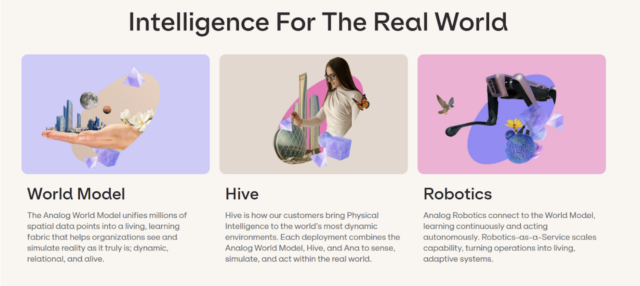
Amy Peck: I would probably build the AR Cloud. There’s a phenomenal company started by Alex Kipman, one of the inventors of Microsoft HoloLens, and it’s called Analog. They’re building the company I would build, moving toward a true AR cloud but starting with digital twins and smart cities. What’s unique is they’re building the hardcore operational back end, data management structures and security in parallel with a front end consumer and constituent experiential layer. They hired phenomenal producers who’ve run capture studios and produced immersive experiences to come and build those experiences. That’s the right way to do it because you have to have the data flows from the back end to the front end and be able to parse everything in between to get to real time data exchange. You also have to deal with the weighting of data because these experiences are heavy. For me it’s a thing of beauty and it’s exactly what I would build.

Could you elaborate on this, what are they building and how does it show up for users and infrastructure?

Amy Peck: I’m going to try to stay in the arena of what I knew beforehand, because I did visit the office and get a demo and it blew me away. They created an experience for the Emirates and Abu Dhabi, and they’re starting with Abu Dhabi, particularly in the cultural center. They’ve dedicated one of the islands to culture, you’ve got teamLab there, you’ve got the Louvre, you’ve got the cultural museum, and they’re building more. They’re starting smart by building the necessary frameworks for the operational component, while also having the wow factor of experiences that are available to constituents. Leadership support is fascinating because it galvanizes Abu Dhabi natives who get to experience what the technology can bring, while invisibly in the background they’re working to improve life through things like traffic management and better ways to interface with government. That invisible layer of intent to improve lives is the part I’m really drawn to.

What does it mean to you to innovate responsibly?

Amy Peck: First and foremost, governance cycles have to move quickly because the technology is changing so fast. I’ve worked with companies where the employee handbook changes one paragraph every five years, but it’s basically the same as it was from the day they were born, and that is not going to work with AI, safety frameworks, and security frameworks. We also have to protect the workforce from hacks because a lot of people use personal devices, so they’re as susceptible as companies are. At the core is securing data. You add biometric devices into the mix and you have to ask where that data is going. I want to see sovereign data and sovereign identity start to take hold, and I want consumers to demand control of their data. There have been incidents where people asked very personal medical questions in the web version of ChatGPT and identifiable characteristics showed up in other people’s responses, and that is dangerous. AI agents proliferating inside systems is also dangerous, because they can circumnavigate security protocols, so we need an identity mechanism for AI agents too.

When it comes to technology, what collaborations are needed to unlock a breakthrough?

Amy Peck: There are some good examples of governments working positively with technology companies, but I’ve always been a believer in convergence. Instead of having an XR center of excellence, a blockchain center of excellence, and an AI center of excellence, the groups making the most traction are commingling those technologies and looking at much more significant ways to converge them. This matters tactically as well. It’s easier when you’re looking at potential solutions at the beginning and integrating them at the beginning, rather than doing the spit and duct tape at the back end that we’ve seen a million times. Integration into legacy systems is always a challenge, and every company struggles with it. I’m sure no offense to Johnson & Johnson, because every company struggles with this, but you want to avoid doing it on the back end.

What needs to happen to catch up on governance, given tech moves fast and governments and organizations cannot keep up?

Amy Peck: The reality may be a little unfortunate. There may be significant negative events, mishaps, and breaches before companies and governments really speed up. The European Union has been making an effort to stay ahead of the curve, the US government the same, and China has a more centralized approach. But we’re missing the bigger picture. We’re so worried about the race to win AI that we’re losing sight of the fact that governments need to collaborate around AI, because we could set up a situation where AI becomes an unseen enemy and infiltrates systems to a degree that we won’t reel back in. I’m not a big believer in dystopian pictures of the future. I believe we’re fundamentally resilient. But if we want to decide how the world looks, this is the time to do it. COVID showed that decisions made in distress are not always the best decisions. It’s almost like a marketing problem: we need to give individuals more voice, educate people, and decide collectively what future we want, not default to what dystopian TV shows suggest.

What have you seen in the Middle East that differs from or aligns with other practices around AI and regulation?

Amy Peck: I can only speak to what I’ve personally seen, but one of the most positive things in the Emirates and in Saudi is that they look at AI and new media not just as entertainment, but as a communication tool for education and to elevate arts and culture. In the West we’ve taken that for granted. There’s something amazing about how quickly governments in the Middle East can enact programs for their constituents, like educational programs and celebrations of culture and art. In Abu Dhabi, you see a cultural center with spectacular art collected in a small geography, and they’re building more museums over the next decade. There are challenges with AI governance for everyone, but I feel a sense of fast, decisive movement. It’s not about being right every time, it’s about being on a path and building structures now. If governance is already in place, it’s easier to make incremental changes than to build everything from the ground up.

And finally, Amy, what does inspiring tomorrow’s world mean to you?

Amy Peck: I’m a big believer in stepping back from your day to day, your to do list, and the things you want to accomplish, and spending time visualizing what you personally want from the future. It’s not a drum circle or a kumbaya moment. It’s important for us to have a vision. If we’re blindly moving toward whatever somebody else says we should be doing, or whatever science fiction writers and governments collectively decide we’re doing, then we haven’t architected the future. For me, inspiring tomorrow’s world is not around prediction. It’s taking a blank canvas and filling it with your desired outcomes. They can be outlandish, ridiculous, not realistic, but have something that is a north star that inspires you. That will start to color and shape the way you approach the day to day. Have a blank canvas with desired outcomes, even if they feel outlandish, and let that inspire how you approach the day to day.